
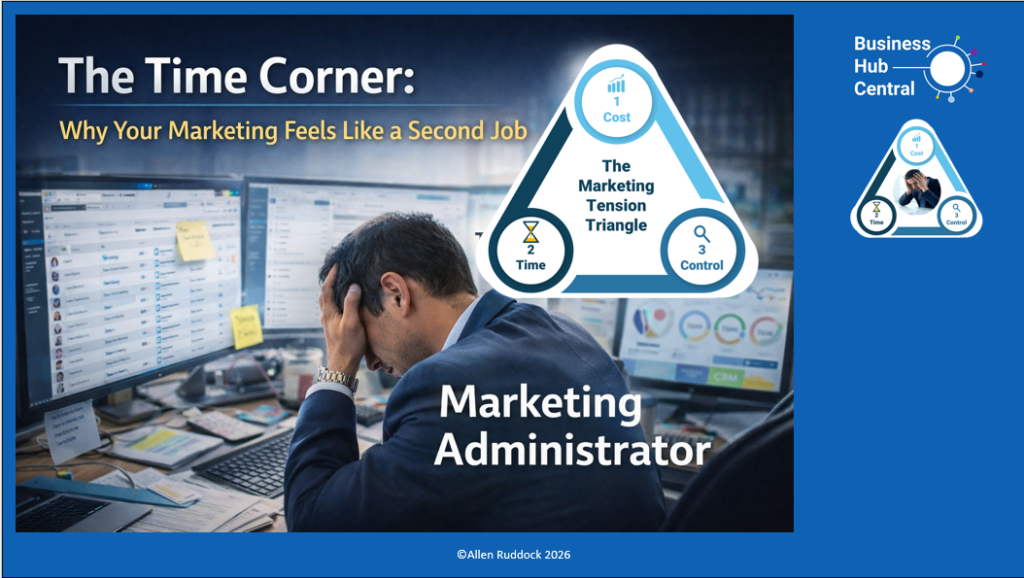
In the previous article in this series, I explored the Cost corner of the Marketing Tension Triangle and how “cheap” marketing tools can quietly become expensive.
But for many business owners, the biggest pressure point isn’t cost.
It’s time.
Marketing gradually becomes something that sits on top of everything else you do.
And before long, it feels like you’ve taken on a second role in your business: Marketing Administrator.
The Hidden Time Drain
Most small business owners don’t notice the problem immediately.
Their marketing stack builds gradually.
A CRM here. An email tool there. A scheduling system. A landing page builder. A form tool.
Individually, these tools work perfectly well.
But when they’re not connected properly, something subtle happens.
You become the integration layer.
You’re the one who has to:
- Move leads between systems
- Check multiple dashboards
- Copy information from one platform to another
- Manually trigger follow-ups
Each task takes only a few minutes.
But those minutes accumulate across the week.
You should be coming up with creative ways to market your business.
Instead, you’re coming up with creative ways to mesh systems and data together.
The Admin Creep
This is what I call admin creep.
Tasks that weren’t part of the original plan quietly expand until they start consuming hours.
Examples include:
- Exporting contact lists
- Checking multiple inboxes
- Updating pipelines
- Sending follow-up reminders
- Manually responding to enquiries
None of these activities generate revenue directly.
But they become necessary because the systems supporting your marketing aren’t working for you. They are working because of you.
The Follow-Up Problem
One of the most common time drains is follow-up.
A lead fills in a form.
Now you need to:
- Send a response email,
- Add them to your CRM,
- Update a pipeline,
- Set a reminder to follow up,
- Possibly send additional information
In a fragmented system, each of these actions may happen on a different platform.
Which means someone has to manage the process.
Usually, that someone is you.
When Marketing Becomes a Second Job
Over time, the result is predictable.
Marketing doesn’t feel like a growth engine.
It feels like administration.
Instead of focusing on strategy, messaging, and relationships, business owners find themselves dealing with:
- Data management
- Tool navigation
- Repetitive tasks
This is where time pressure inside the Marketing Tension Triangle becomes obvious.
Because when systems are fragmented, time expands to fill the gaps between them.
The Structural Fix
Reducing time pressure rarely comes from working harder.
It comes from designing systems that remove manual steps.
When key parts of marketing sit inside one ecosystem – including:
- CRM
- Communications (not just email, but SMS, WhatsApp, social media DMs etc.)
- Automation
- Reporting
- Scheduling
- Task assigment
something important happens.
Processes become automatic.
Follow-ups trigger themselves.
Leads move through pipelines without manual intervention.
And the hours previously spent on admin begin to shrink.
The necessary admin gets delegated through the automation. Controls are built in.
Time Is the Corner Most Businesses Underestimate
Cost pressures are easy to measure.
Control issues are easy to feel.
But time loss often goes unnoticed because it happens gradually.
Yet over the course of a year, fragmented marketing systems can quietly consume hundreds of hours.
Which raises an important question.
A Question Worth Asking
If you ditched your marketing admin workload tomorrow, would your marketing stop?
Or could your systems continue doing most of the work automatically?
The goal isn’t to spend more time on marketing.
It’s to build systems that allow marketing to happen without the admin constantly needing your attention.
That leaves you free to be the creative spark that grows the business.
Successful business owners become the marketers of what they do, NOT the marketing administrators of what they do.