
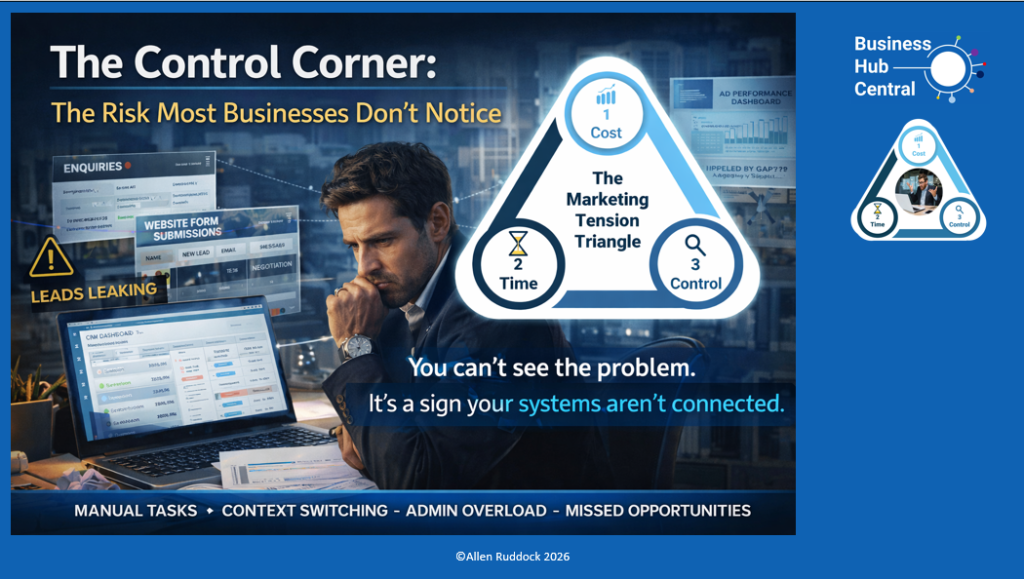
In the previous two articles in this series, we explored the Cost and Time corners of the Marketing Tension Triangle.
Now we come to the third corner. – Control.
And this is often the corner that business owners think least about… until something goes wrong.
What Control Really Means in Marketing
Control doesn’t mean doing everything yourself.
It means having visibility.
It means being able to answer questions like:
- Where did this lead come from?
- What stage is this opportunity at?
- Which campaign generated the enquiry?
- What happens after someone makes contact?
When your marketing systems are connected, those answers are easy to find.
When systems are fragmented, they become much harder.
The Visibility Problem
Many businesses have data everywhere.
But insight nowhere.
For example:
- Enquiries arrive via email
- Forms sit on a web page
- Leads live in a CRM
- Marketing emails are in another platform
- Analytics live somewhere else entirely
Each system holds part of the picture.
But none show the whole story. There is no single place where it all comes together.
So when you, as the business owner, ask, “What’s actually working?” the answer becomes guesswork or hard work to pull it all together.
The Outsourcing Risk
Loss of control also appears when marketing is outsourced without proper system visibility.
Agencies may run campaigns effectively.
But if the data lives inside their platforms, the business itself can lose sight of:
- Lead sources
- Conversion rates
- Customer journeys
The marketing may still work.
But the business becomes dependent on external reporting to understand its own pipeline.
The Lead Leakage Problem
Another control issue appears when systems don’t communicate properly.
This is where leads quietly fall through the cracks.
Examples include:
- Enquiry emails that don’t enter the CRM
- Forms that don’t trigger follow-up
- Missed messages on different platforms
- Pipeline stages that aren’t updated
Individually, these seem like small operational issues.
But over time, they create lead leakage.
Opportunities simply disappear.
Why Control Strengthens the Whole Triangle
When control improves, something interesting happens.
Other parts of the triangle also improve.
Better visibility means:
- Smarter marketing decisions
- Fewer wasted campaigns
- Clearer performance tracking
This often reduces costs or, better still, increases the return on that investment!
And when systems are connected, automation improves visibility and saves time.
Control isn’t about micromanagement. It isn’t about doing everything yourself.
It’s about clarity and visibility.
Bringing the Triangle Together
Cost, time, and control are not separate issues.
They’re connected forces.
When marketing systems are fragmented, tension increases between all three.
But when infrastructure becomes more integrated:
- Costs stabilise
- Time pressure reduces
- Control improves
That’s the real purpose behind the Marketing Tension Triangle.
Not to eliminate tension.
But to design marketing systems that keep it in balance.
A Final Reflection
If your marketing sometimes feels chaotic, expensive, or time-consuming…
Its probably not a strategy problem.
It may simply be that your systems were never designed to work together.
And when structure improves, marketing becomes something very different.
Not a constant trade-off.
But a system that quietly supports the growth of your business.