
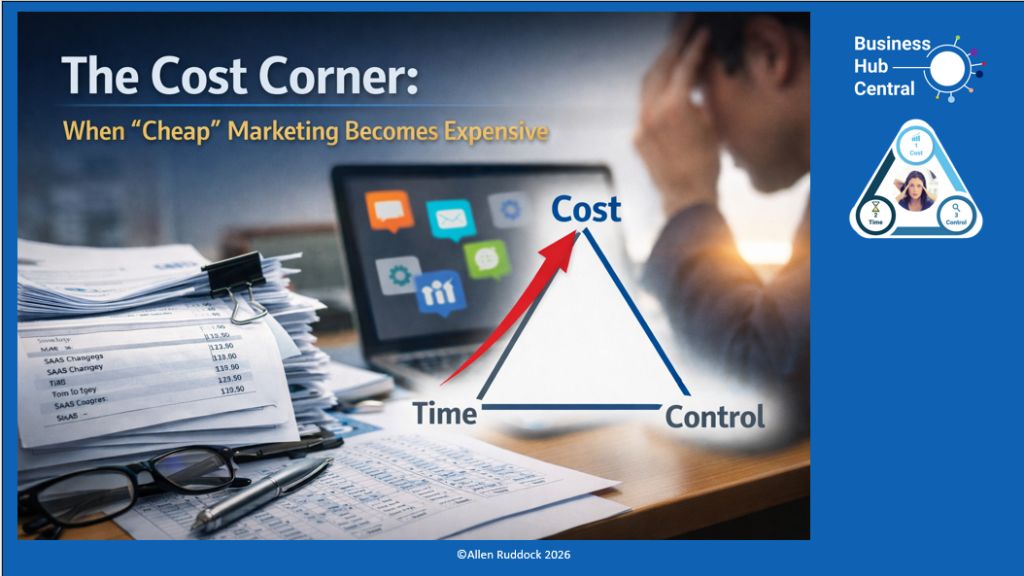
In the first blog in this series, I introduced the idea of the Marketing Tension Triangle – the constant challenge of balancing Cost, Time, andControl in small business marketing.
Most businesses try to optimise one or two of those corners.
But when you push too hard on one corner of the triangle, pressure appears somewhere else.
This article focuses on the Cost Corner, and why what looks like cheap marketing often ends up costing far more than expected.
The “Cheap Stack” Trap
Many small businesses build their marketing setup step by step. It’s what I did in my early businesses.
It usually looks something like this:
- A CRM system (often a spreadsheet to start with)
- An email marketing platform (the free or cheap versions of Mailchimp or AWeber, for example)
- A landing page builder (LeadPages or Click Funnels, perhaps)
- A scheduling tool (Calendly)
- A form builder (WordPress plug-in?)
- A social media scheduler (Buffer, SocialOomph etc.)
- A quiz creation tool (ScoreApp)
- A review management tool
Individually, none of these tools seems expensive.
You might pay:
- £20 per month here
- £35 per month there
- £49 (or more) for something else
Each purchase feels manageable.
But over time, the stack grows.
The cost of each component also grows as your volumes increase or you need extra bells and whistles.
What started as a couple of tools quietly turns into six, eight, or even ten different subscriptions.
Suddenly, the “cheap option” doesn’t look so cheap.
The Hidden Costs (the ones nobody spots or calculates)
Monthly subscription totals are only part of the picture.
The real cost often hides elsewhere.
1. Overlapping Functionality
Many marketing tools now include similar features.
Your email platform might include:
- Landing pages
- Basic CRM functionality
- Forms
Your CRM might include:
- Email campaigns
- Pipeline automation
- Reporting
But because the tools were added at different times, you end up paying for the same capabilities twice. Sometimes those capabilities only come at a higher price point.
2. Integration Workarounds
When systems don’t naturally talk to each other, businesses start connecting them using integrations or automation tools.
These might involve:
- Middleware platforms
- Webhooks
- Third-party connectors
They can work — but they add complexity.
And sometimes another subscription.
3. The Cost of Inefficiency
The biggest cost is rarely the subscription itself.
It’s the friction between tools.
For example:
- Copying leads from one system to another
- Checking multiple dashboards
- Exporting and importing data
- Manually updating pipelines
These tasks don’t appear as separate lines on your profit and loss statement.
But they consume time every week.
And time, ultimately, is money.
So, a marketing stack that looks inexpensive on paper can quietly become expensive through:
- Duplicate tools
- Inefficiency
- Lost opportunities
- Admin overhead
The irony is that many businesses choose fragmented tools specifically to save money.
Yet the fragmentation itself creates the very costs they were trying to avoid.
The Structural Question
The real question isn’t:
“How can we find cheaper marketing tools?”
It’s:
“How can we reduce the number of systems required?”
When platforms consolidate functions like:
- CRM
- Communication
- Automation
- Reporting
- Scheduling
… something interesting happens.
The triangle shifts.
Costs often stabilise or reduce.
Time pressure decreases because systems connect.
Control improves because data sits in one place.
Tension reduces!
Looking Ahead in the Series
In the next article, we’ll move to another corner of the triangle – Time.
Because while cost pressures are visible, the time cost of fragmented marketing systems is often hidden and even greater.
Many business owners discover that marketing hasn’t just become complicated.
It has quietly become a second job.
A Question to Consider
If you added up:
- Every marketing subscription
- Every integration tool
- Every hour spent moving data between systems
Would your current setup still feel like the “cheap option”?
Or is the real cost hiding in the gaps between your tools?