
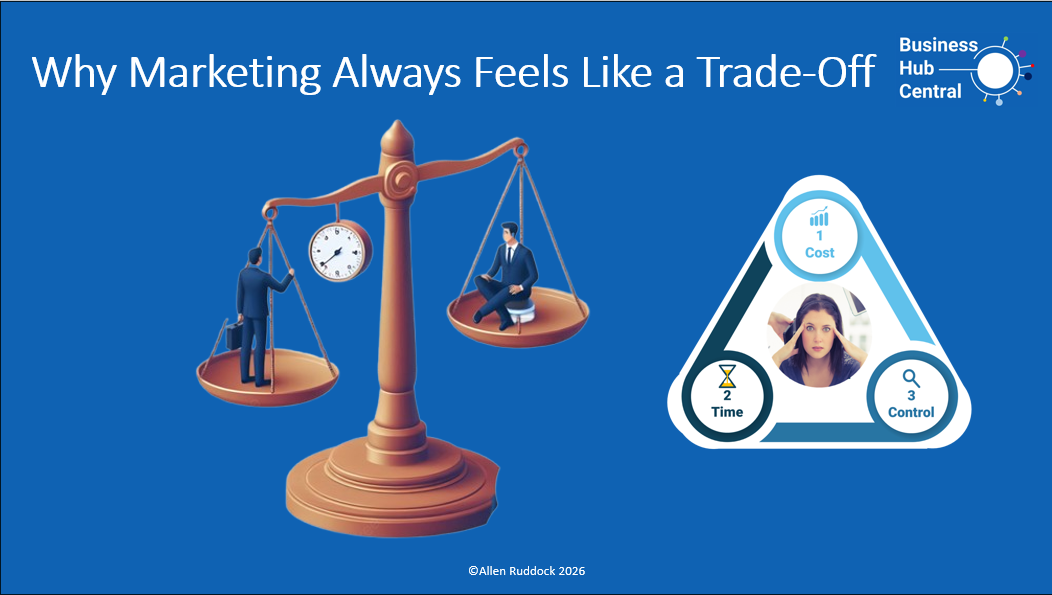
In the first blog in this series I introduced the concept of the Marketing Tension Triangle
It’s a simple idea:
Every small business marketing system is pulled between three forces:
- Cost
- Time
- Control
If you haven’t read that piece yet, it sets the foundation for this one. (You can find it on our blog here: https://hubcentral.co.uk/blog/.)
But here’s the deeper truth:
Marketing feels hard not because you’re bad at it. It feels hard because you’re constantly negotiating trade-offs.
And most of those trade-offs are structural — not strategic.
The Trade-Off Nobody Talks About
When business owners tell me marketing feels frustrating, some of it is about creativity. But even when they have the right content, there is still way more frustration.
They need to get the content out there. They need to follow up on its impact. They need to assess how it performs.
That’s when I hear one of these:
- “I don’t want to spend more money on tools.”
- “I don’t have time to follow up properly.”
- “I don’t really know what’s happening in the pipeline.”
Those are not marketing failures.
They’re tension symptoms. Trade-off symptoms.
Let’s break down what’s really going on.
Trade-Off #1: Keep Costs Low… Spend More Time
This is the most common setup.
You choose:
- A cheaper email platform
- A separate CRM
- A landing page builder
- A booking tool
- Maybe a spreadsheet to hold it all together
Individually, none of them feel expensive.
But together?
You’re juggling tabs. Copying data. Manually updating pipelines. Switching between inboxes.
The financial cost may look controlled.
But the time cost quietly explodes.
And time is the one resource you can’t get back.
Trade-Off #2: Save Time… Lose Control
So you outsource.
You bring in an agency. You delegate campaigns. You hand over the ads. You let someone “handle the marketing.”
Suddenly you’ve bought back time.
But something else creeps in:
- You’re not sure where leads originate.
- The leads are not the right ones to build a sustainable, profitable business*.
- You don’t fully understand your conversion rates.
- You rely on reports you didn’t build.
- Changes take longer because you’re not in the system.
You gain breathing room.
But you lose visibility. You lose control!
And without visibility, scaling becomes guesswork.
*Note: I worked with one client that outsourced their social media marketing. Leads were generated, but they were for one-off appointments. They weren’t the recurring appointments the business needed. There was also a lack of reporting and transparency from the agency
Trade-Off #3: Keep Control… Accept the Overload. This is the driven founder path.
You want to understand everything. You want to see every lead. You want to optimise every stage.
So you:
- Build your own funnels.
- Manage your own email sequences.
- Watch your own dashboards.
- Respond personally to enquiries.
You maintain control.
But you become the bottleneck.
Marketing becomes another operational role you perform — not a system that supports you.
The Pattern Behind the Pattern
Here’s what most businesses don’t realise:
These trade-offs aren’t inevitable.
They’re symptoms of fragmented infrastructure.
When your:
- CRM lives in one place
- Emails in another
- Conversations somewhere else
- Reporting in a different dashboard
You’re forced into trade-offs.
Because your systems aren’t designed to reduce tension.
At best, they’re cobbled together.
The Structural Solution
The goal isn’t to eliminate cost, time or control pressures.
It’s to reduce the tension between them.
When marketing systems are consolidated:
- Costs reduce because tools overlap less.
- Time reduces because workflows automate follow-up, tasks and tracking.
- Control increases because data lives in one ecosystem.
That’s not about buying more software.
It’s about designing infrastructure properly.
That’s the thinking behind what we build inside Business Hub Central – not just campaigns, but connected systems.
Because when structure improves, trade-offs soften.
And marketing stops feeling like a constant, frustrating negotiation.
A Question Worth Asking
If your marketing feels heavier than it should…
Is it really a strategy issue?
Or is it the silent friction between cost, time and control?
Most business owners try to solve trade-offs with tactics.
Better ads. More content. New funnels.
But sometimes the smarter move is structural.
And structure changes everything.